
Cleveland People Directory Map
Cleveland people directories do not sit in one database. Current public contacts appear in municipal, county, and state lists. Property owners appear in assessment and deed indexes. Licensed people and businesses have their own state searches. For past residents, the Cleveland/Bradley County Public Library History Branch holds the richest mix of newspapers, court material, military files, and family collections. The right directory depends on whether the goal is a current public role, an owner name, a licensed identity, or a historical connection.
| Cleveland directory | People named | Record keeper | How to use it |
|---|---|---|---|
| City staff directory | Officials and staff | City of Cleveland | Current web directory |
| County office pages | Officeholders and department contacts | Bradley County | Free department browse |
| State agency directory | State agencies and employees | State of Tennessee | Free web search |
| Assessment and deed indexes | Owners and document parties | Assessor and Register of Deeds | Web portals and office counters |
| License and business searches | Professionals, firms, and agents | Tennessee Commerce and Secretary of State | Free basic searches |
| Obituary name index | People named in local newspaper notices | History Branch | Free index; copies by request |
| Historical local sources | Past residents and family networks | History Branch and TSLA | Catalog, microfilm, and staff help |
Start with the narrowest public role that is already known. An office or agency name points to a staff list. An address points to the owner roll and parcel map. A trade points to license verification. A death date or family name points to the obituary index and archives. These people directories identify different relationships, so a matching name should be checked against a title, parcel, middle name, date, or office before two entries are treated as the same person.
Cleveland City Staff Directory
The City of Cleveland staff directory is an organizational directory, not a list of residents. It is useful when a name is tied to a city department, board, or public duty. Published city entries may lead to an office, work contact, or department page. The official interface was not stable enough during research to verify every search box or result field, so do not assume a home address, private phone, or complete employee roster will appear.
The City of Cleveland directory interface supplied the captured view; check the live source for its current controls and entries.
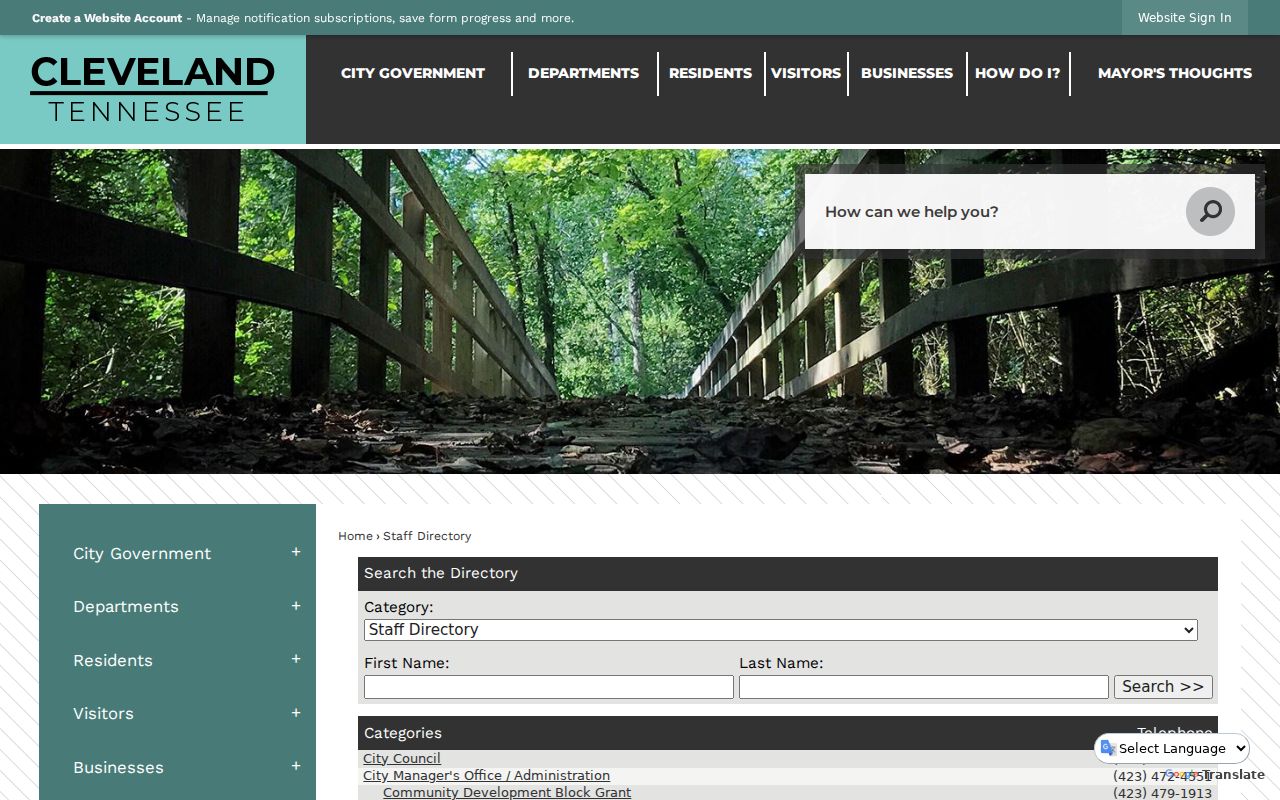
Department pages, meeting packets, agendas, and board rosters can fill gaps when a staff name does not appear in the main interface.
| Entry element | What an official office page can establish |
|---|---|
| Name and title | The named officeholder or public role |
| Department | The unit responsible for the public function |
| Office address | A government building or courthouse room, not a residence |
| Phone, fax, or email | Published work contact channels |
| Hours and services | When and why to contact that office |
If the name is absent, browse the department first and then use its main line. For a past board member or official, search dated minutes. A targeted Tennessee Public Records Act request may reach an existing public roster, but the office does not have to create a new list. Access rules and request steps belong with Cleveland public records.
Cleveland Government Contact Directories
Bradley County pages work as a second government directory because Cleveland is the county seat. Entries commonly show the officeholder, statutory role, courthouse room, direct phone, fax, email, hours, and service links. That format is especially useful when the person sought works in deeds, licensing, courts, elections, assessment, GIS, taxes, or county administration. It gives a reliable work identity while keeping personal contact information separate.
The Tennessee agency and employee directory extends the search statewide. Its captured interface provides another official path when a Cleveland connection involves a state program rather than city or county government.
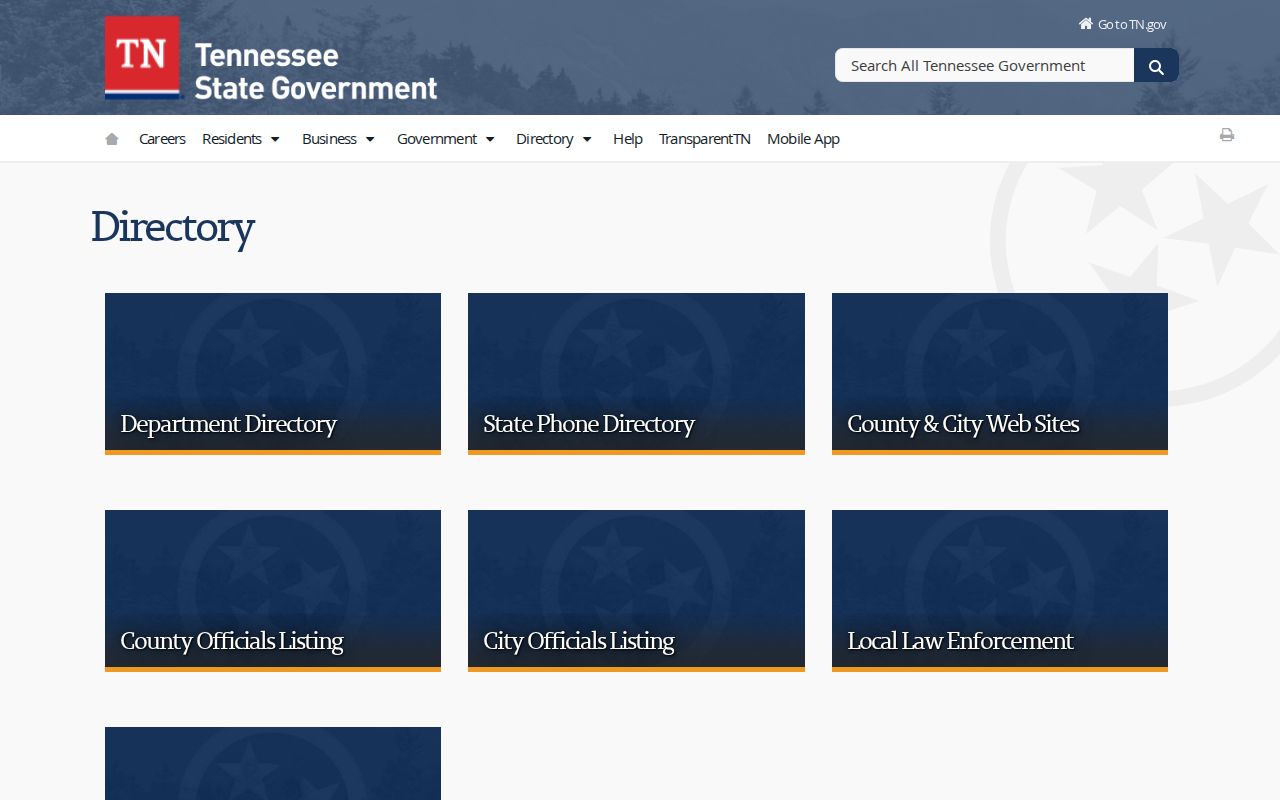
The state entry should be read as a work contact. Confirm the agency and role, since a shared surname alone does not resolve identity.
County government hours are Monday through Thursday from 8:30 a.m. to 4:30 p.m. and Friday from 8:30 a.m. to 5 p.m. When a directory stops at a department name, call during those hours and ask for the office that keeps the record, not for private details about an employee.
Cleveland Education Directory Limits
Education directories can identify faculty and staff roles at Bradley County Schools, Cleveland State Community College, and local institutions. Research did not confirm a stable, field-by-field public interface for the school district or college. That gap matters. A broken route does not prove that a person is absent, and likely fields such as subject, campus, phone, or email should not be published as facts until the live directory is inspected.
Use a school or college site search, then browse its campus or department pages. Archived catalogs, commencement programs, yearbooks, and local newspaper coverage form a separate historical path. Current student rosters are not presumed public. Alumni lists and private institutional groups may also restrict access, so a public staff directory should never be stretched into a broad student or alumni search.
Note: Institutional directories describe public roles and published affiliations; they do not establish a person's current home address or private contact details.
Cleveland Property Name Directories
The Bradley County assessment and GIS hub links assessment data, the Tennessee Property Viewer, tax maps, voting maps, and a separate City of Cleveland map. Together they act like an owner directory. Search paths should be tested by owner name, street address, and parcel number. A parcel card may connect an owner to a mailing address, physical location, land description, values, classification, and sale history, but the research could not verify every live result field.
Cleveland address geography has a sharp edge. County zoning excludes Cleveland and Charleston, and a postal Cleveland address can sit outside city limits. Use the parcel boundary and city map before selecting a permit, zoning, tax, or police office. Keep directional suffixes such as NW, NE, SE, and SW. Mailing address and situs address also mean different things: one receives tax mail, while the other locates the parcel.
Address caution. An owner record does not prove who occupies a property. Confirm a personal link with another dated, official or archival source.
Cleveland Deed Party Directory
The Bradley County Register of Deeds turns recorded instruments into a name index. Its official office page links TitleSearcher for deeds, mortgages, releases, powers of attorney, restrictions, plats, and other filings. Names are indexed by legal role, not by a general resident search. Search both sides of a transfer, along with initials, alternate spellings, former names, estates, trusts, and business names.
- Grantor
- The party transferring or granting an interest.
- Grantee
- The party receiving that interest.
- Situs address
- The physical location assigned to a parcel.
- Instrument number
- The durable filing identifier used to retrieve a recorded document.
A deed hit can lead to a recording date, document type, book and page or instrument number, and legal-description reference. The county does not state the first online year or anonymous image terms on its page. Use the Register counter or call 423-728-7240 when the web index fails, and ask whether the public terminal covers more years.
Cleveland Business License Directories
Two state systems and one local office answer different business identity questions. The Tennessee Secretary of State business search can show an entity, status, formation information, principal office, registered agent, and filing history. A registered agent is not necessarily an owner. Bradley County Clerk handles local business licensing and offers online processing, while official copies or older local entries may require its Room 101 counter.
The Tennessee license verification portal supports individual or business name, name within a license type, license number, city, and county searches. Pick a license class to cut down same-name collisions. Then confirm the license number, type, status, issue or expiration facts, and any official discipline link with the responsible board.
- Individual or business name: make a broad first pass, then compare the license type and location.
- Name within license type: narrow a known trade and confirm the board and license number.
- License number: match the exact credential, status, and named holder.
- City or county: explore Cleveland or Bradley County entries without assuming same-name results identify one person.
Cleveland Obituary Name Directory
The Cleveland/Bradley County Public Library obituary index is the strongest verified historical name directory in Cleveland. It reaches from 1865 to the present, is described as a beta service, and is updated daily. Indexed newspapers include the Cleveland Daily Banner, Copper City Advance, and Bradley County Journal. Search first name, last name, or both, then filter the loaded results.
| Obituary directory field | Input | How it helps |
|---|---|---|
| First Name | Optional text | Try formal and familiar forms |
| Last Name | Optional text | Try married, maiden, and spelling variants |
| Filter Results | Optional text | Narrows results already returned |
| Result details | Index output | Middle name, nickname, age, date, paper, page, and notes |
An index row points to a newspaper item, not an official death finding. Request the page from the History Branch for $2, then compare it with a death index, certificate, cemetery source, or family record. Email hbranch@clevelandlibrary.org or call 423-479-8367. A mailed request needs a self-addressed stamped envelope.
Cleveland History Branch Directories
The History Branch occupies the 1866 Craigmiles House, which has served as a library since 1922. Its local collections reach far beyond printed people directories: county court records from the earliest years, newspapers on microfilm from 1854 through 1970, family and local histories, photographs, scrapbooks, manuscripts, military records, pensions, and Southern Claims Commission files. The Mayfield Papers preserve legal correspondence from 1895 through 1929.
Newspaper Microfilm
1854 to 1970
Families, businesses, notices, and community events
Obituary Index
1865 to present
Decedents, relatives, nicknames, and publication details
Mayfield Papers
1895 to 1929
Clients, lawyers, estates, disputes, and addresses
Military and Claims Files
Bradley and nearby counties
Soldiers, widows, claimants, witnesses, and neighbors
Exact years for city, reverse, and phone directories are not published. Do not claim a Cleveland directory year or publisher without checking the shelf list. Call the branch before planning a year-by-year address trail. If no printed volume covers the date, use census schedules, deeds, tax records, newspaper notices, and obituaries. Public census schedules currently run through 1950; the 1960 schedule remains closed until 2032.
Note: Fragile History Branch items may not be copied, and researchers select their own microfilm while following the collection's handling rules.
Cleveland Directory Identity Checks
A directory entry is a lead with a date and purpose. Government pages show public roles. Assessment rolls show ownership, not occupancy. Deed indexes show parties to a filing. License systems show a credential or business status. Obituary indexes show a reference to a newspaper item. None should be treated as a universal resident list.
Repeated Cleveland surnames and initials make cross-checking essential. Compare middle names, nicknames, spouses, relatives, parcel numbers, public roles, ages, and chronology. Preserve the exact returned spelling and the date viewed. For an old address, keep its directional suffix and determine whether it falls inside Cleveland city limits. For archival work, note the newspaper, page, collection name, and keeper so someone else can retrieve the same item.
Lawful use. Use people directories for legitimate personal, civic, family-history, and consumer-safety work. Never use an address or contact detail to stalk, harass, threaten, or defeat Safe at Home protections.